Buyers spend months laser-focused on saving for the down payment, and then get genuinely surprised at the closing table by a second, entirely separate chunk of money they still owe upfront. Closing costs aren’t secretly hidden from you exactly, but they’re rarely explained clearly during the early stages of house hunting, which is exactly why so many buyers underestimate them until the final numbers actually land in their inbox a few days before closing.
What Closing Costs Actually Cover in Practice
Closing costs are the collection of fees and expenses beyond the home’s actual purchase price that are needed to finalize the loan and legally transfer ownership of the property. They typically run somewhere between 2 and 5 percent of the total loan amount, which on a $300,000 loan could mean anywhere from roughly $6,000 to $15,000 due at closing, on top of your down payment.
The Main Categories You’ll Actually See on Your Statement
Loan origination fees are charged directly by the lender for the work of processing your application and underwriting the loan. Appraisal fees cover the cost of a professional, independent valuation of the home to confirm it’s worth what you’re paying. Title insurance and title search fees protect both you and the lender against any future ownership disputes or unknown liens on the property. Attorney or escrow fees may apply depending on your specific state’s legal requirements around real estate closings. Recording fees are paid directly to your local government to officially record the transaction in public records. Prepaid items typically include the first year of homeowners insurance paid in full upfront, along with several months of property taxes deposited into an escrow account. And points are an entirely optional upfront payment you can choose to make in exchange for a lower interest rate over the life of the loan, if that trade-off makes sense for your specific timeline.
Who Actually Pays What Portion
Buyers typically cover the bulk of total closing costs in most transactions, but in a lot of markets, sellers can be persuaded to cover a meaningful portion as part of the negotiation, especially in a slower market where sellers are more motivated to actually close the deal quickly. This is a completely normal, routine thing to negotiate as part of your purchase offer, and asking for seller concessions doesn’t make you look inexperienced or unreasonable to the other side. It’s genuinely standard practice in real estate transactions.
Ways to Actually Lower the Total Bill
Compare loan estimates from multiple lenders side by side, since fees charged for what are technically the same underlying services can vary more between lenders than most buyers expect going in. Ask the seller directly to cover a portion of your closing costs as part of your initial offer negotiation, particularly if the home has been sitting on the market for a while. Consider a no-closing-cost loan structure, where the lender rolls those upfront costs into a slightly higher interest rate instead, though you’ll want to run the actual math on whether that trade-off is genuinely cheaper for you over the specific time you plan to hold the loan. And try timing your closing date near the very end of a calendar month to reduce the amount of prepaid daily interest you owe, since that interest accrues daily from your closing date through the end of that same month regardless of when in the month you close.
The Loan Estimate Document Is Your Best Comparison Tool
Within three business days of formally applying for a mortgage, lenders are legally required to provide you with a standardized Loan Estimate document that breaks down all projected closing costs in the same consistent format across every lender. This makes it genuinely easy to compare offers side by side across different lenders, so actually use this document rather than skipping past it. A lot of buyers simply go with the very first lender they happened to talk to without comparing, which usually isn’t the cheapest option available to them.
A Concrete Walkthrough
Picture a buyer purchasing a $320,000 home with a $290,000 loan after their down payment. Their loan estimate shows roughly $9,200 in total closing costs, broken down into origination fees, an appraisal, title insurance, prepaid taxes, and a full year of prepaid homeowners insurance. By negotiating with the seller during a slower selling season, the buyer secures a $4,000 seller credit toward closing costs, cutting their actual out-of-pocket cash needed at closing nearly in half. This is exactly the kind of negotiation that’s available far more often than first-time buyers assume, particularly outside of extremely competitive seller’s markets.
Red Flags Worth Watching For on Your Statement
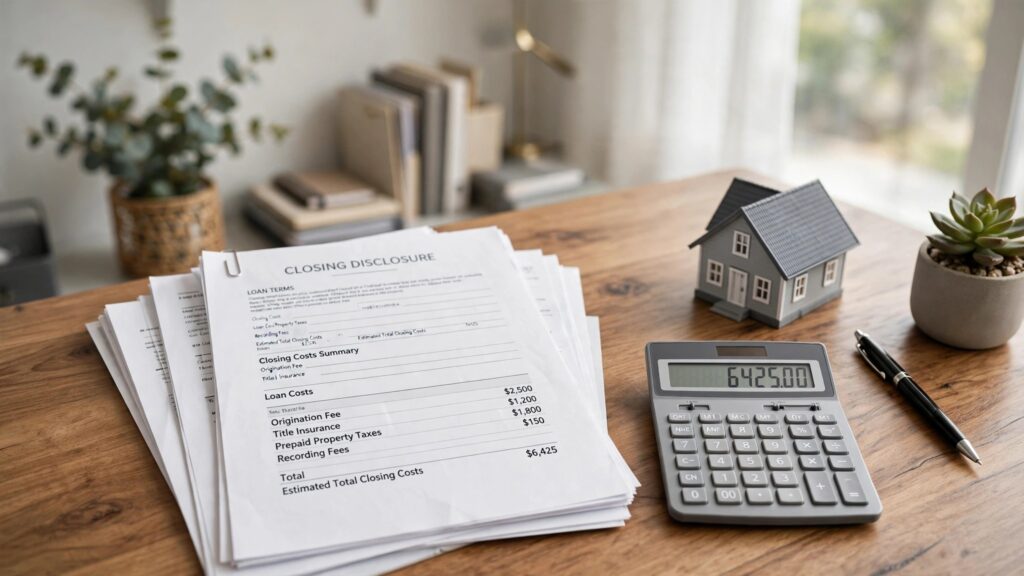
Watch for fees that appear suddenly on your final closing disclosure that weren’t present on your original loan estimate, since lenders are generally required to explain any significant increases. Be cautious of unusually high or vaguely labeled processing fees that don’t clearly map to a specific service performed. And always compare your final closing disclosure against your original loan estimate line by line rather than just checking the total figure at the bottom.
How Closing Costs Interact With Down Payment Assistance
Some down payment assistance programs can also be applied toward closing costs rather than only the down payment itself, depending on the specific program’s rules. If you’re already researching assistance for your down payment, it’s worth asking directly whether any portion can be redirected to cover closing costs instead, since not every buyer needs the full assistance amount applied to the down payment alone.
Why Your Loan Type Changes the Closing Cost Picture
FHA and VA loans carry their own specific fee structures that differ somewhat from conventional loans, including an upfront funding fee on VA loans and a mortgage insurance premium built into FHA closing costs. This is worth factoring in when you’re comparing loan programs side by side during pre-approval, since a loan with a slightly higher rate but lower upfront fees might actually cost less at the closing table than one advertised with a marginally better rate.
State and Local Variation Worth Checking
Closing cost norms vary more by state than a lot of buyers expect. Some states require attorney involvement in every real estate closing, adding a legal fee that doesn’t exist in states where escrow companies handle the process instead. Transfer taxes, charged on the sale itself, also vary enormously by state and even by county, sometimes adding thousands of dollars that a buyer moving from a different state simply didn’t anticipate based on their previous experience.
What a Cash Buyer’s Closing Costs Look Like Instead
Buyers purchasing without a mortgage still face closing costs, just a narrower set. Without a loan, there’s no origination fee, no mortgage insurance premium, and often no lender-required appraisal, though many cash buyers choose to get one anyway for their own peace of mind. Title insurance, recording fees, and any attorney or escrow fees still apply regardless of financing, since those relate to the property transfer itself rather than the loan.
Getting a Head Start on Your Closing Cost Budget
As soon as you have a rough sense of your target price range, ask a lender for an early, informal estimate of what closing costs might look like on a loan that size. It won’t be exact until you have a specific property under contract, but it gives you a real number to start saving toward well before you’re deep into house hunting, rather than discovering the figure for the first time after you’re already under contract and on a tight timeline.
Where This Leaves You
Closing costs aren’t optional, and pretending they simply don’t exist until the week before closing is exactly how buyers end up scrambling for extra cash at the worst possible moment in the entire process. Budget for them from the very start, right alongside your down payment savings goal, and you’ll walk into closing day with considerably less financial stress than the alternative approach of hoping it all somehow works out.