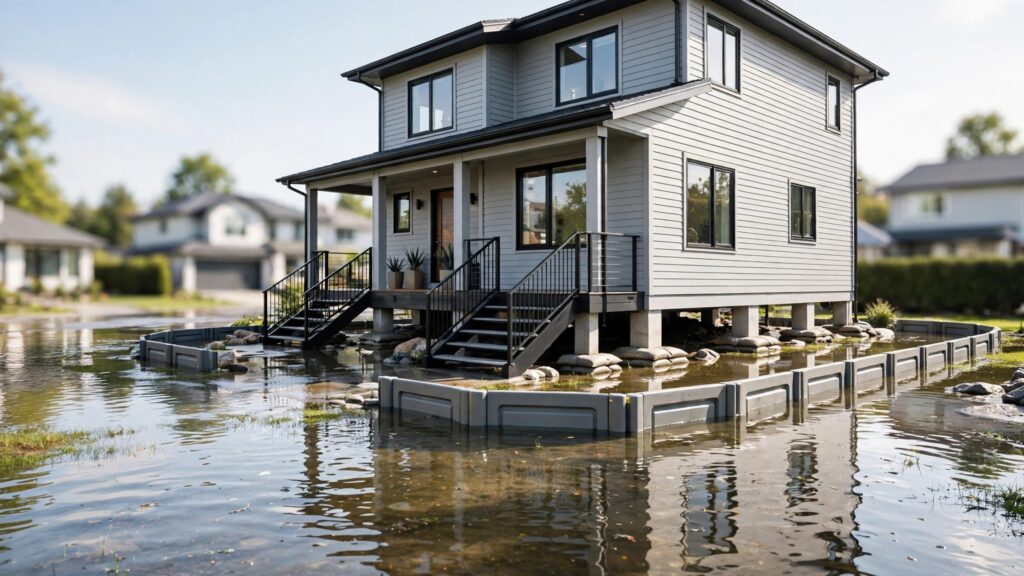
Flood damage is one of the most common and most expensive natural disaster costs homeowners face, and it’s also one of the most widely misunderstood gaps in coverage. A lot of people assume their standard homeowners policy already protects them against flooding. It doesn’t, and that misunderstanding has left plenty of families paying for flood damage entirely out of pocket after a disaster.
Why Standard Homeowners Policies Exclude Flooding
Flood damage is treated as a separate category of risk from the perils covered under a standard homeowners policy, largely because flooding tends to affect entire regions simultaneously rather than isolated individual properties, which makes it a different kind of insurable risk from a house fire or a single burst pipe. This is exactly why flood insurance exists as its own separate product, most commonly through the National Flood Insurance Program, rather than being bundled into an ordinary homeowners policy.
Do You Actually Need It
If your home sits in a designated high-risk flood zone, your mortgage lender likely already requires flood insurance as a condition of the loan, so the decision has effectively already been made for you. But flooding isn’t confined to officially designated flood zones. A meaningful share of flood insurance claims each year come from properties outside high-risk zones, following unusually heavy rainfall, rapid snowmelt, or nearby development that changes how water drains through an area. Living outside a mapped flood zone reduces your risk, but it doesn’t eliminate it entirely.
How Flood Insurance Is Actually Structured
Flood insurance through the National Flood Insurance Program typically separates coverage into building property and personal contents, purchased either together or separately depending on your needs and whether you rent or own. Building coverage handles the structure itself, including the foundation, electrical and plumbing systems, and built-in appliances. Contents coverage handles your personal belongings, furniture, electronics, and clothing, similar in concept to personal property coverage under a standard homeowners policy, just for flood-specific damage instead.
The Waiting Period You Need to Plan Around
Most flood insurance policies carry a 30-day waiting period before coverage actually takes effect, meaning you can’t simply buy a policy the moment a storm is forecast and expect immediate protection. This waiting period is exactly why flood insurance needs to be arranged well ahead of hurricane season or any other predictable period of elevated flood risk in your specific region, rather than treated as a last-minute purchase once a storm is already approaching.
What Flood Insurance Typically Doesn’t Cover
Flood policies generally don’t cover temporary living expenses if you’re displaced during repairs, unlike the loss of use coverage found in standard homeowners policies. They also typically exclude damage to items stored in basements beyond a certain basic level, like unfinished drywall or specific mechanical systems, and they don’t cover currency, precious metals, or valuable papers stored in the affected area. Reviewing these exclusions carefully before assuming you’re fully covered is worth the time it takes.
Cost Considerations Worth Knowing
Flood insurance premiums vary considerably based on your specific flood zone designation, your home’s elevation relative to the base flood elevation, and the age and construction of the structure itself. Homes in lower-risk zones often pay a modest annual premium, while homes in high-risk zones directly on a floodplain can pay considerably more. It’s worth getting an actual quote for your specific address rather than assuming a general cost figure applies to your situation.
A Realistic Scenario
Consider a homeowner just outside an officially mapped flood zone who skips flood insurance, reasoning that their home has never flooded before. A few years later, unusually heavy regional rainfall combined with new upstream development sends floodwater into the basement, causing tens of thousands of dollars in damage to mechanical systems and stored belongings. Because the standard homeowners policy excludes flood damage entirely, and no separate flood policy was in place, the full repair cost falls on the homeowner directly, illustrating exactly why proximity to an official flood zone boundary isn’t the same thing as being genuinely safe from flood risk.
Private Flood Insurance as an Alternative
Beyond the National Flood Insurance Program, a growing number of private insurers now offer their own flood insurance policies, sometimes with higher coverage limits or more flexible terms than the federal program provides. Comparing a private flood quote against the federal program’s rate is worth doing before assuming the government program is automatically the only or the cheapest option available for your specific property.
How Flood Zone Maps Get Updated Over Time
Flood zone designations aren’t permanent. They get revised periodically as agencies incorporate new data on rainfall patterns, development, and waterway changes, which means a property once considered low risk can be reclassified into a higher-risk zone years later, sometimes triggering a new lender requirement for coverage that didn’t exist when the home was originally purchased. Checking your current flood zone designation periodically, rather than assuming the status from years ago still applies, is a simple habit worth adopting.
What to Do If You’re Renting in a Flood-Prone Area
Renters can also purchase flood insurance for their personal belongings, since a standard renters policy excludes flood damage just like a homeowners policy does. If you’re renting in an area with any real flood history, it’s worth asking your insurance agent for a contents-only flood policy rather than assuming your landlord’s coverage, or lack of coverage, has any bearing on protecting your own belongings.
Flood Risk and Your Broader Insurance Picture
Flood insurance is worth discussing alongside your other coverage decisions rather than in isolation, particularly if you’re already comparing bundling options with your current carrier, since some insurers can arrange flood coverage through a partner program even if they don’t underwrite it directly themselves.
The Bottom Line
Flood insurance isn’t just for homes sitting directly in a mapped high-risk zone. If your area has any history of heavy rainfall, nearby waterways, or changing drainage patterns from new development, it’s worth getting a real quote rather than assuming you’re automatically safe simply because a map doesn’t officially label your specific property as high risk.