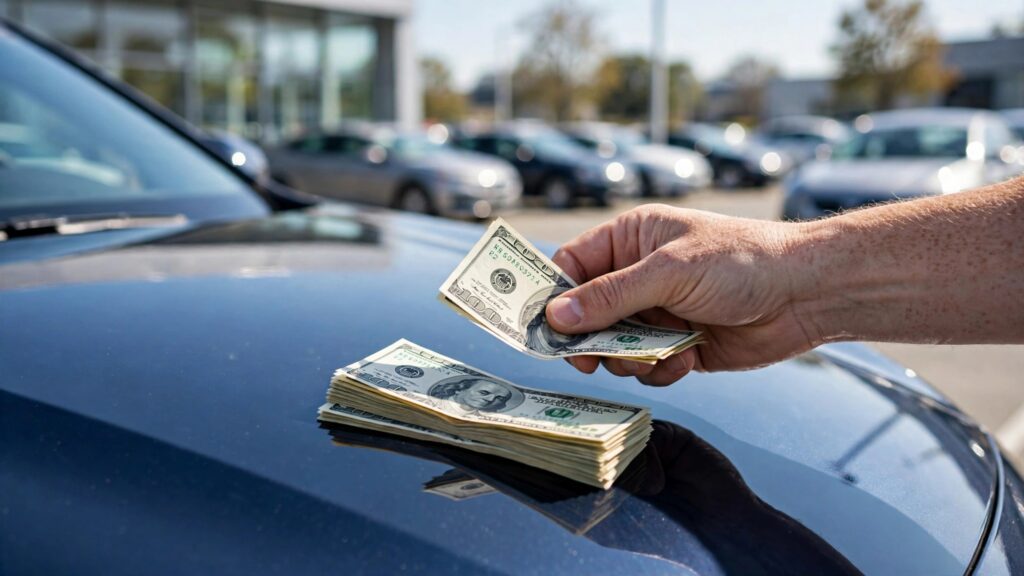
A down payment on a car loan does more than just reduce your loan amount, it shapes your interest rate, your monthly payment, your risk of ending up underwater on the loan, and even whether you qualify for financing at all in some cases depending on the specific lender involved. Treating the down payment as an afterthought, rather than a deliberate part of the overall financing decision, means missing out on several of these connected benefits.
The Direct Impact on Your Loan Amount
The most obvious effect of a down payment is straightforward, every dollar you put down is a dollar you don’t need to borrow, directly reducing your loan principal and the total interest that accrues on that principal over the life of the loan. A larger down payment on an identical vehicle purchase means a smaller loan, a lower monthly payment, and less total interest paid by the time the loan is fully satisfied.
How Down Payment Size Affects Your Interest Rate
Beyond simply reducing the loan amount, a larger down payment can sometimes help you qualify for a better interest rate, since it improves your loan-to-value ratio from the outset, presenting less risk to the lender if the vehicle needs to be repossessed and resold at any point during the loan term. Some lenders offer tiered rate structures that specifically reward a larger down payment percentage with a modestly better rate, making it worth asking directly whether a specific lender’s rate offer changes at different down payment levels.
How Much Should You Actually Put Down
A commonly cited guideline suggests putting down at least 20 percent on a new vehicle and at least 10 percent on a used vehicle, though these are general starting points rather than universal requirements, and your specific situation, available savings, and the lender’s own minimums all factor into what’s genuinely right for your particular purchase. Putting down more than these guidelines suggest, if you have the available cash and it doesn’t compromise your emergency savings, further reduces your risk of being underwater and lowers your total interest cost even more.
The Risk of a Minimal or Zero Down Payment
Some dealerships and lenders advertise zero down payment options, and while these can genuinely help buyers without significant savings get into a needed vehicle, they come with real trade-offs, a larger loan amount, a higher monthly payment, more total interest paid, and a considerably higher risk of being underwater during the loan’s early months when depreciation is steepest. This is exactly the scenario where gap insurance becomes particularly worth considering, given the elevated risk a minimal down payment creates.
Balancing Down Payment Against Your Emergency Fund
Draining your entire emergency fund to maximize a down payment isn’t necessarily the wisest move, even though it might reduce your loan costs. Maintaining a reasonable cash reserve for genuine emergencies matters more than squeezing out every possible dollar of down payment savings, and finding a balance, a solid but not all-consuming down payment while preserving some emergency cushion, tends to serve most buyers better than an all-in approach that leaves no financial buffer remaining.
Trade-In Value as an Alternative to Cash Down Payment
If you own a vehicle outright, or one with positive equity, trading it in functions as a down payment without requiring additional cash out of pocket, directly reducing your new loan amount by whatever your trade-in is actually worth. It’s worth getting an independent valuation of your trade-in before visiting a dealership, since dealer trade-in offers can vary and an independent estimate gives you a real benchmark for evaluating whether a specific offer is reasonable.
How a Down Payment Affects Loan Term Decisions
A larger down payment sometimes opens up the option of a shorter loan term while keeping the monthly payment manageable, since the reduced loan amount means less principal to pay off within a compressed timeframe. This connects directly to the broader decision of choosing between a short-term and long-term auto loan, since a solid down payment can make a shorter, lower-total-interest term genuinely feasible where it might not have been with a minimal or no down payment at all.
A Practical Example
Consider a $25,000 vehicle financed two different ways. With a $1,000 down payment, the loan amount is $24,000, resulting in a higher monthly payment and more total interest over the loan term. With a $5,000 down payment, the loan amount drops to $20,000, meaningfully reducing both the monthly payment and the total interest paid, while also starting the loan with a healthier loan-to-value position that closes the underwater risk window considerably faster.
What to Do if You Can’t Afford a Substantial Down Payment
If a large down payment genuinely isn’t feasible right now, consider a less expensive vehicle that better matches what you can comfortably put down, rather than stretching for a pricier vehicle with minimal money down. Alternatively, delaying the purchase by a few months to build additional savings specifically for a down payment can meaningfully improve your overall financing terms, sometimes enough to justify a short wait if your current vehicle situation allows for it.
How Your Credit Score Interacts With Down Payment Requirements
Borrowers with weaker credit scores sometimes face higher minimum down payment requirements than borrowers with stronger credit, since lenders use the larger down payment to offset some of the additional risk a lower credit score represents. This means a down payment that might be optional for a borrower with excellent credit could be a genuine requirement for approval at all for a borrower with weaker credit, making it worth clarifying a specific lender’s minimum requirement for your particular credit profile before assuming a standard percentage applies universally regardless of credit standing.
Down Payment Sources Worth Considering Beyond Cash Savings
Beyond straightforward cash savings, some buyers use a portion of a tax refund, a work bonus, or proceeds from selling another asset as a down payment source, effectively accelerating their timeline to a solid down payment without needing to save from scratch over many months. It’s worth avoiding financing a down payment itself through a personal loan or credit card, however, since this defeats much of the purpose of a down payment in the first place, adding a second debt obligation on top of the auto loan rather than genuinely reducing your overall borrowed amount.
Down Payments on Leased Versus Financed Vehicles
The role of a down payment differs somewhat between leasing and financing, since a lease’s upfront payment lowers your monthly payment without building any ownership equity, unlike a financed vehicle where the down payment directly reduces the amount you’ll eventually own outright. Anyone weighing whether to lease or finance should factor this distinction into how they think about an upfront payment, since the same dollar amount serves a genuinely different purpose depending on which path you choose.
How Seasonal Sales Events Interact With Down Payment Planning
Manufacturers and dealerships sometimes offer down payment matching promotions or reduced down payment requirements during specific sales events, typically tied to model year changeovers or holiday sales periods. While these promotions can genuinely help buyers who are down payment constrained, it’s worth evaluating whether the underlying vehicle price and interest rate are still competitive, since a promotional down payment incentive attached to an otherwise mediocre overall deal doesn’t necessarily represent genuine savings once the complete picture is considered.
How Down Payment Expectations Have Shifted Over Time
Average down payment amounts have shifted over the years, influenced by vehicle prices, average loan terms, and broader lending standards at any given time. What counted as a typical down payment percentage a decade ago isn’t necessarily the same benchmark lenders and buyers use today, which is worth keeping in mind rather than anchoring to an outdated figure you might have heard from a friend or family member’s own car-buying experience from years earlier.
Negotiating the Vehicle Price Separately From Your Down Payment
It’s worth negotiating the vehicle’s purchase price as its own conversation, entirely separate from how much you’re putting down or what your target monthly payment looks like. Dealerships sometimes prefer to discuss deals purely in terms of monthly payment, since this framing can obscure a higher overall vehicle price behind an acceptable-looking monthly figure achieved through a longer term or a larger down payment. Insisting on agreeing to the vehicle’s price first, before any discussion of down payment or financing terms, keeps the negotiation focused on the actual cost of the car rather than a monthly number that can be manipulated in several different directions to look appealing regardless of the underlying total cost.
The Bottom Line
A down payment isn’t just a formality on the way to financing a vehicle, it’s one of the more powerful levers available for controlling your total cost, your monthly payment, and your risk exposure throughout the loan. Putting real thought into how much to put down, rather than defaulting to whatever minimum a lender requires, pays off in ways that extend well beyond the day you drive off the lot.


